Peptide Testing: Hplc & Mass Spec Pureness Overview Apex
Recognizing Peptide Purity: What 99%+ Truly Suggests
In vivo tests assess absorption, circulation, metabolic rate, and excretion (ADME) qualities, additionally validating efficiency and safety. These screening services not just help clients enhance items specifically throughout growth but additionally offer solid information support for regulative compliance of peptide formulas. Be cautious of COAs that offer a pureness number without any supporting chromatographic information, report purity without specifying the logical technique, or checklist a molecular weight without mass spectrometry confirmation. Tandem mass spectrometry (MS/MS or MS ²) fragments the peptide ions in the gas stage and analyses the piece masses. This is the gold criterion for peptide identity-- it verifies both the make-up and the sequence. For several peptide jobs, absolute peptide amount matters as much as chromatographic purity.- These evaluations are important when customers need more than a mass range and chromatogram to evaluate whether a lot is genuinely fit for quantitative work.
- Beware of laboratories that do not use mass spectrometry along with HPLC, as this could miss crucial identification information.
- Matching HPLC, laboratories make use of Mass Spectrometry (commonly coupled as LC-MS) to validate the peptide's molecular weight and series identification.
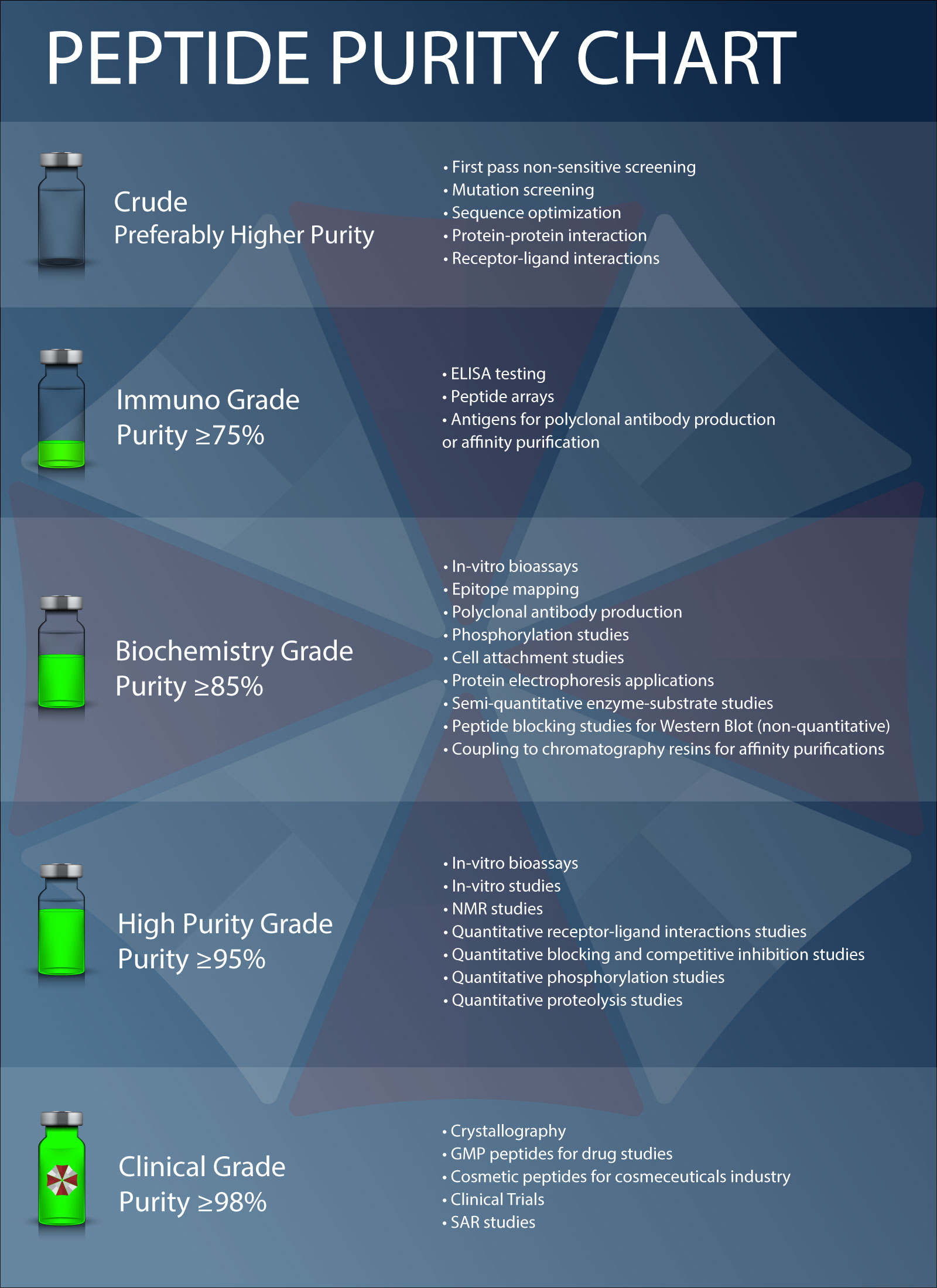
What Do Pureness Levels 95%, 98%, 99% Mean?
We can supply expert peptide pureness determination services utilizing analytical reversed-phase HPLC paired with mass spectrometry. Each peptide is carefully monitored during the analytical cycle according to rigid logical quality control and biosynthetic quality control criteria. HPLC is exceptional at addressing the inquiry "how pure is this example by chromatographic area percent? " It does not, by itself, prove that the primary top is the intended peptide.
FDA and the European EMA have actually established standards mandating comprehensive evaluation and quality control for peptide products to make sure safety and effectivenessr. In the context of pharmaceutical or clinical-grade peptides, laboratory recognition is indispensable to meeting these guidelines. For example, prior to a peptide medication can enter human trials, its maker must show the identity, pureness, potency, and security of the peptide via validated logical methods. Peptide purity testing data are necessary in preclinical research studies and need to premium SARMs products be consisted of in investigational brand-new medication (IND) applications and later on new medication applications (NDAs).What To Search For In A Certification Of Analysis
Quality Control And Item Conformity In The Pharmaceutical Sector
Various other strategies like electrophoresis, capillary electrophoresis (CE), and nuclear magnetic resonance (NMR) can likewise be made use of to examine peptide structure, charge, and pureness, guaranteeing thorough characterization. In COA evaluation, it typically consists of HPLC purity testing, mass spectrometry identity verification, and batch-specific documentation revealing the examined great deal, approach, results, and day. For peptide pureness testing, reverse-phase HPLC is the conventional conceptual version. The chromatographic pureness is after that computed by comparing the area under the main peak with the complete area under all incorporated heights.Peptide testing is the collection of analytical checks used to review a peptide example prior to it is utilized in a research process. In practical COA testimonial, the term typically describes purity testing, identity testing, and paperwork evaluation. Purity screening asks just how much of the spotted sample is the major peptide versus related contaminations. Identity testing asks whether the measured mass or sequence-related evidence matches the designated peptide. Documentation evaluation asks whether the report is batch-specific, traceable, and described enough to be examined. Peptide testing is the analytical process utilized to verify that a study peptide is both pure and correctly recognized.
Likewise, keep in mind that "research-grade" peptides are meant for the lab bench and include high purity and identification checks however are not generated as medicines. Always inspect that your peptide includes appropriate logical data (HPLC chromatogram and MS outcomes) and is identified for research study usage. Armed with this knowledge, you can with confidence interpret labels like "95% purity, research study quality" and use those peptides to drive your experiments without complication. Understanding of pureness levels will certainly also direct you if you ever need a higher purity peptide for a specifically sensitive assay. In the end, getting the purity level right means extra reliable scientific research-- and that's the ultimate goal for any kind of scientist. With years of logical screening experience and progressed tool platforms, BOC Sciences offers thorough peptide top quality screening services across the whole procedure from resources to solutions. The software attracts borders around each top and computes the area below. The pureness percent comes from contrasting the area of the major optimal to the complete area of all discovered tops. Many reports consist of a table listing each top's retention time, area, and percent of overall location.