Peptide Purity Analysis Service
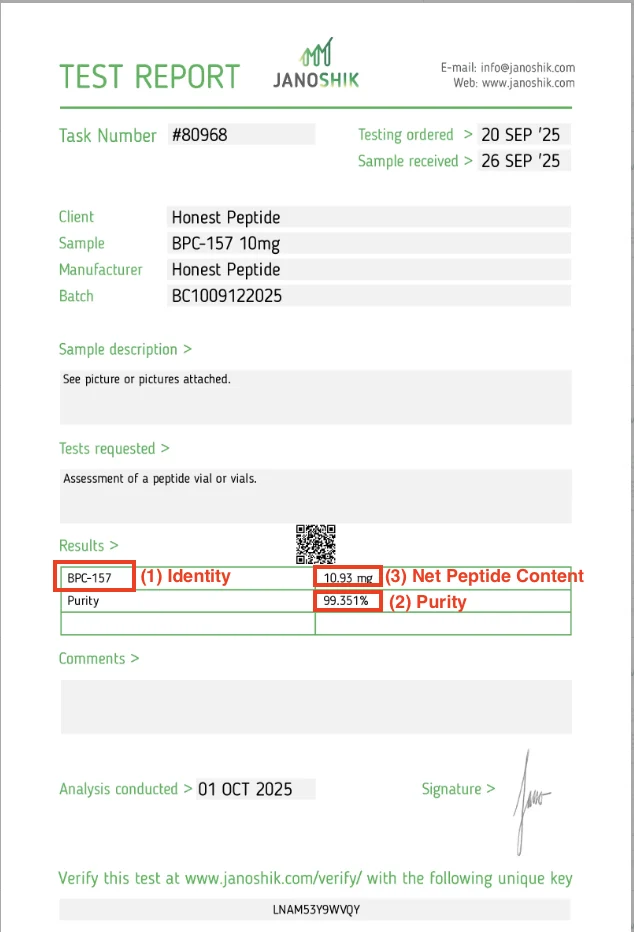
Verified > 99% Lab-grade Peptides
Straight from the synthesizer with marginal processing-- typically simply bosom from the material and rainfall. Pureness ranges extensively, from 40% to 80%+ relying on series length and trouble. Unrefined peptides appropriate for applications where pureness isn't essential, such as antibody manufacturing or preliminary testing assays where the target peptide simply needs to be existing, not leading. Closely associated with truncations, removal peptides are full-length chains that are missing one amino acid someplace in the middle. If covering isn't flawlessly effective, an uncoupled chain can continue to lengthen in succeeding actions, generating a peptide that's only one residue short of the target.- Our laboratory utilizes modern instrumentation and verified methodologies to make certain accurate, reproducible data across also the most intricate peptide matrices.
- When a peptide is 98% pure, that remaining 2% isn't arbitrary sound-- it specifies, recognizable types of results.
- You can find out more regarding our logical screening procedures on our screening and high quality page.
- One more related term you may experience is internet peptide content, which is various from purity.
What Can We Supply?
Other spectroscopic methods, such as Infrared (IR) or UV-Vis analysis, are sometimes used for rapid quality checks or architectural confirmation. This is why trusted vendors give both HPLC and MS information on their Certifications of Evaluation. Peptides in microspheres and nanoparticles may ensnare with matrices, making it difficult to separate totally free and encapsulated types. We use dialysis, ultrafiltration incorporated with HPLC/UV techniques to medically examine encapsulation performance and medicine loading. These evaluations are important when customers need greater than a mass range and chromatogram to evaluate whether a great deal is absolutely fit for quantitative job.Residuals Testing